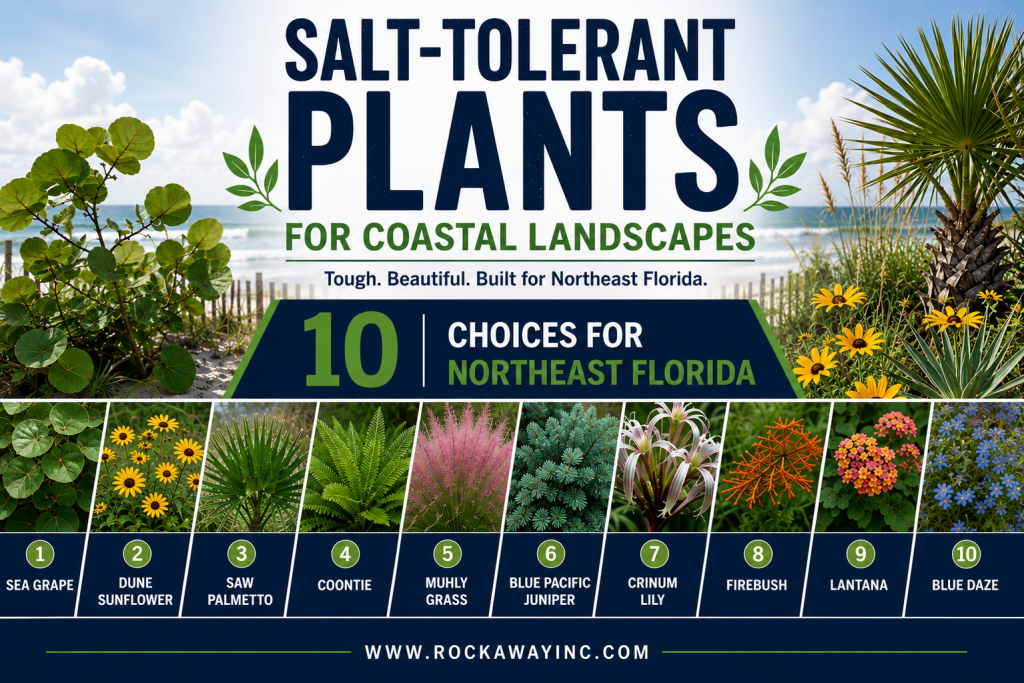

A beautiful coastal landscape starts with plants capable of handling the conditions that come with living near the water. Living near the coast is one of the great advantages of Northeast Florida. For plants, however, the same ocean breezes homeowners enjoy can create a challenging growing environment. Salt spray, wind, intense sunlight, sandy soils and periods of drought can all influence which plants perform well along the coast. Move just a few miles inland and growing conditions can change considerably.
That’s why plant selection in Jacksonville Beach, Neptune Beach, Atlantic Beach and Ponte Vedra Beach should involve more than choosing something that looks good at the nursery. The right plant in the wrong place is still the wrong plant.
Here are 10 plants worth considering for salt-exposed Northeast Florida landscapes.
1. Sea Grape
Few plants say “Florida coast” quite like sea grape. Its large, rounded leaves and naturally spreading form make it an attractive choice for coastal landscapes, and its ability to tolerate salt spray makes it particularly useful close to the ocean. Mature plants can become quite large, so sea grape works best where it has room to develop. Sea grape can also provide screening and help create a more natural coastal appearance.
Landscape tip: Don’t treat sea grape like a small foundation shrub. Consider its mature size when determining placement and remember that pruning of protected dune vegetation may be subject to local or state regulations.
2. Dune Sunflower
For homeowners looking for something lower-growing, dune sunflower brings cheerful yellow flowers to some surprisingly difficult locations. This Florida native naturally occurs in coastal environments and handles sun, sandy soils, and salt exposure well. Its spreading growth makes it useful as a groundcover in informal landscapes. The flowers also provide resources for pollinators.
Landscape tip: Give dune sunflower room to spread. It’s particularly effective when the objective is a natural Florida coastal look rather than a tightly manicured planting.
3. Saw Palmetto
Saw palmetto is one of Florida’s most recognizable native plants—and one that’s naturally adapted to some tough conditions. Its fan-shaped foliage provides strong texture and structure without relying on flowers for visual interest. Established plants can tolerate sandy soils and coastal conditions while fitting naturally into native and low-maintenance landscape designs. However, this isn’t a small plant.
Landscape tip: Consider mature spread carefully. Saw palmetto can become substantial and is much easier to accommodate when adequate space is planned from the beginning.
4. Coontie
Coontie provides a very different texture. This Florida native cycad develops attractive fern-like foliage and can work well in beds, borders and mass plantings. Once established, it is relatively drought-tolerant and can perform well in many coastal situations. It also has an important ecological connection: coontie is the larval host plant for the Atala butterfly.
Landscape tip: Coontie works particularly well when repeated throughout a planting rather than treated as a single isolated specimen.
5. Muhly Grass
Muhly grass provides something many landscapes are missing: movement. Its fine-textured foliage moves with the breeze, while its distinctive pink-purple flower plumes can create an impressive display in fall. Muhly grass is native, handles Florida heat and can tolerate coastal conditions. It works particularly well in masses where the plants create a larger visual effect.
Landscape tip: Give muhly grass adequate sunlight and resist the temptation to trim it into a small ball continually. Its natural form is part of its appeal.
6. Blue Pacific Juniper
Blue Pacific juniper offers a low-growing evergreen option for coastal landscapes. Its spreading habit and blue-green foliage can provide contrast against palms, ornamental grasses, and flowering plants. It also handles sunny, well-drained conditions particularly well. Rockaway has used Blue Pacific juniper in coastal landscape designs where salt exposure and sandy conditions influence plant selection.
Landscape tip: Drainage matters. Salt tolerance doesn’t mean a plant will tolerate constantly saturated roots.
7. Crinum Lily
Crinum lilies bring considerably more drama to the landscape. Their large, strap-like foliage creates a tropical appearance, while tall flower stalks can produce clusters of white, pink or striped blooms. Many crinums perform well in Florida’s heat and can tolerate coastal conditions, making them useful where a larger accent plant is appropriate.
Landscape tip: Give them space. A mature crinum can become much larger than the plant you initially bring home from the nursery.
8. Firebush
Firebush brings together summer color and wildlife value. Its orange-red tubular flowers are attractive to hummingbirds and butterflies, and the plant can flower extensively during Florida’s warm season. Native firebush is also well adapted to Florida’s climate and can handle a degree of coastal exposure.
Landscape tip: Firebush performs best when its natural growth habit is considered in the design. Constant heavy shearing can reduce flowering and eliminate much of the character that makes the plant attractive.
9. Lantana
Heat, sunshine and sandy soil can be difficult conditions for many flowering plants. Lantana generally handles them remarkably well. Its colorful flower clusters attract butterflies and provide dependable warm-season color. Established plants can also be relatively drought-tolerant. But plant selection requires some care. Florida has native Lantana species as well as nonnative varieties, and some nonnative forms present invasive concerns.
Landscape tip: Don’t choose solely by flower color. Know which Lantana you’re buying and whether it’s appropriate for your landscape.
10. Blue Daze
Blue Daze provides a striking splash of blue without taking over the landscape vertically. Its low-growing habit makes it useful along borders, walkways and hardscapes, and it generally performs well in sunny, hot conditions. The silvery-green foliage provides visual interest even when flowers aren’t fully open.
Landscape tip: Blue Daze prefers good drainage. That’s one reason it can work particularly well in Northeast Florida’s sandy coastal soils.
Not All Coastal Properties Have the Same Salt Exposure
This is where coastal plant selection becomes more complicated. A home directly facing the Atlantic Ocean can experience considerably more salt spray and wind than a home several blocks inland. Buildings, dunes, fences, and existing vegetation can further change how much exposure plants receive. There is also an important difference between salt spray, salty soil, and saltwater flooding. A plant capable of tolerating airborne salt carried by ocean breezes isn’t necessarily capable of surviving roots submerged in brackish or saltwater after a coastal flooding event. That distinction becomes increasingly important in low-lying coastal landscapes.
Sandy Soil Creates Another Challenge
Salt isn’t the only issue near the beach. Much of Northeast Florida’s coastal soil is extremely sandy. Water can move through it rapidly, and nutrients can leach from the root zone faster than they would in heavier soils. That creates an interesting combination: a property can receive substantial summer rainfall and still have plants experience dry conditions surprisingly quickly. It is another reason irrigation should be designed around actual site conditions rather than simply increasing watering whenever plants appear stressed.
Wind and Sun Matter Too
Coastal plants can also experience intense sunlight and persistent wind. Wind increases moisture loss from foliage, while reflected heat from driveways, patios, pools, walls and other hardscape can make already-hot summer conditions even more demanding. A plant located against a protected east-facing wall may therefore perform very differently from the same species planted on an exposed ocean-facing corner.
Salt-Tolerant Doesn’t Mean Maintenance-Free
This distinction is important. A plant being adapted to coastal conditions doesn’t mean it requires no irrigation, pruning, fertilization or other care. Newly installed plants still need time and appropriate watering to establish root systems. Mature size still matters. Irrigation still matters. Soil and drainage still matter. The objective isn’t to find plants that require no care. It’s to choose plants whose natural requirements are compatible with the site so you’re not constantly fighting the environment to keep them alive.
Right Plant, Right Place Matters Even More at the Coast
Successful coastal landscaping starts by looking at the property before looking at the plant list. How close is the property to the ocean? How much direct salt spray reaches the landscape? Is the soil predominantly sand? Does the property experience occasional flooding? Which areas receive intense afternoon sun? Where are plants protected by the house or existing vegetation?
Those answers help determine which plants belong where. A plant can look beautiful at the nursery and still be a poor investment if the conditions waiting for it at home aren’t appropriate. For Northeast Florida coastal landscapes, thoughtful plant selection can mean the difference between continually replacing struggling plants and creating a landscape that looks like it actually belongs at the beach.
A good coastal landscape doesn’t fight its environment. It’s designed around it.